

29 December 2022
John Wilson Kidd, affectionately known to his students as “Cap,” and considered one of the most influential supporters of student life and athletics, joined the School of Mines when it opened in 1914 as a member of its first faculty. He served as acting dean of the college from 1 December 1922, until 31 August 1923, while Dean Steve Worrell was away on sabbatical. The regents appointed Kidd dean on 1 September 1923 to replace Worrell, who President Robert Vinson had removed as dean earlier in the year. Kidd served as dean of the college until to 31 August 1927. After stepping down, he remained on the faculty and served as dean of engineering until his death in 1941.
Kidd personified the school’s rugged, can-do engineering spirit during its early years. Born in Atkins, Arkansas, on 11 December 1880, Kidd attended Oklahoma A&M College in Stillwater, receiving his Bachelor of Science degree in 1904. In 1906 he enrolled at Texas A&M College, teaching electrical engineering and physics and, in 1909, graduated with an electrical engineering degree. He left Texas to serve as superintendent of the Light and Water Works Plant in Pawnee, Oklahoma, and as an engineer for General Electric at Schenectady, New York. The construction of Elephant Butte Dam and the desert climate attracted Kidd to the Paso del Norte region in 1912, joining the U.S. Reclamation Service. In 1913, he worked as a draftsman for El Paso´s city engineering department.
College teaching appealed to Kidd. A professor of engineering and mathematics, he also spent his summers teaching mathematics in the county’s summer teacher training program. A firm believer in the benefits of collegiate athletics, he volunteered to serve as the school’s first athletic director. He contributed his skills to building the school’s first football field at the Paso del Norte campus, which students and alumni later lobbied to have named in his honor.
Gruff and amiable, Kidd inspired many of his male engineering students, serving as a mentor to many. As for the growing number of female students, Kidd believed they had no place in the engineering profession, a common stance shared with fellow engineers during this era. On more than one occasion, Kidd informed would-be female engineering majors that he would never allow them to pass his calculus course, which the curriculum required for graduation. One female student, Carrie Crosby, reached senior status in 1928, earning more than enough credits to graduate. All she lacked for her mining degree was a passing grade from Kidd’s math course. While he did not mind non-engineering students enrolling to earn teaching credentials and transfer credits at the tuition-free school, Kidd mockingly referred to them “peedoggies,” a corruption of pedagogy, the term for teaching.
Kidd delighted heading a small engineering school. But when civic leaders in 1927 successfully lobbied the state to have the College of Mines expand its curricula to include liberal arts courses, Kidd stepped down as dean of the college, not wanting to serve as the head of a much larger comprehensive regional college. He remained on the faculty and served as dean of engineering and superintendent of buildings. Kidd directed crews, which often included his engineering students, in the construction of roads, walls, sidewalks, and other improvements throughout the campus. When the new Paso del Norte campus opened, he organized the relocation of a processing mill (today’s Seamon Hall) from the El Paso tin mine to the new campus, adjacent to the site of the practice mine. He personally designed and superintended the renovation of the Power House into a new engineering building (today’s Prospect Hall), the addition to Seamon Hall, and the Geology Lecture Room (today part of Quinn Hall). In the early 1930s, he dynamited tons of rock to a lower level of the Main Building (today’s Old Main). His skill with explosives was legendary, having, in the words of one staff member, “never cracked the foundation nor broke a single windowpane.” The regents allowed Kidd and his family to move into the home designed and built by Steve and Kathleen Worrell, which the university had purchased earlier. Known today as Heritage House, Kidd made extensive renovations to the structure to accommodate his family.
After the U.S. entry into World War II in December 1941, Governor Beauford Jester appointed Kidd mining coordinator for the state to assist with their war effort. The honor was short-lived, as Kidd passed away from influenza and heart failure on 29 December 1941. After his death, a group of colleagues and former students established the Kidd Memorial Foundation, which later established the Kidd Seismic Observatory in his memory on 11 November 1961. Kidd is the only individual to have two structures on campus given this honor.
Philanthropic Deeds
From the day the School of Mines opened in 1914, John Kidd proved to be one of its most enthusiastic supporters, volunteering his time and resources to support a myriad of causes. One such cause was the school’s fledgling athletic program. In addition to stepping in as its first athletic director in 1914, he also solicited the community for financial support. According to Francis Fugate’s 1964 history of UTEP, Frontier College, one apocryphal exploit has Kidd donating $800 out of his own pocket to pay for uniforms.[1] Sadly, no convincing evidence exists to support this claim. Such a contribution, worth over $21,000 today, would surely have been noteworthy at the time, earning him at least a mention in the minutes of the board of regents or the school’s annual reports. Kidd’s annual income in 1915 was $2,000, which meant the 34-year-old-professor, with a wife and children, would have made a truly generous contribution amounting to forty percent of his annual income. A more plausible explanation of the contribution can be found in the faculty minutes of 2 November 1921, when Dean Steve Worrell reported to the faculty that citizens of El Paso had contributed $825 to the athletic fund through Kidd’s solicitation efforts.[2] Kidd excelled at button-holing local leaders and businesses into supporting the school, earning him the distinction of being UTEP’s first development officer.
There is no doubt that Kidd, along with the rest of the faculty, did contribute to the College of Mines. The faculty minutes record contributions by faculty, including one effort where they agreed donate six-tenths of one percent ($6 for every $1,000) of their salaries to cover a deficit in the athletic fund.[3]
Nickname
A recent legend has it that John Kidd received his nickname “Cap” from his habit of walking around campus with blasting caps in his pocket. As superintendent of buildings, he often performed demolition work around rocky, hillside campus—enlarging a basement here and removing a boulder there. But did he really walk in the presence of others carrying dangerous, volatile blasting caps? And was this the origin of his nickname?
A trained engineer, Kidd assumed the responsibility for maintaining the buildings on the Paso del Norte campus. With little budget to work with and a gung-ho attitude, Kidd proved to be a superb construction planner and supervisor, relying on elbow grease to get jobs done. Construction drawings for various projects drawn by him and his students can be found in the Special Collections of the University Library. Former students in oral histories describe assisting or observing Kidd at work, taking pride in the fact that his work was so meticulous that there was rarely any collateral damage from his use of explosives. Construction work building Centennial Plaza, which opened in 2015, was delayed for months as workers struggled to demolish decades-old underground utilities designed and built by Kidd that proved surprisingly durable.
Analyzing these stories and the records of construction on campus that required demolition, the time period places them in the 1930s. The earliest mention of blasting on campus involving Kidd was a Prospector article from 11 September 1931, which tells an amusing story of Kidd instructing a student on the proper use of a blasting battery. Francis Fugate tells the story of Frances Stevens, who arrived on campus in 1931, and witnessed the start of the blasting under Kidd’s supervision. The earliest dates provided by oral histories on Kidd’s expertise with dynamite, such as those provided by William Strain and Pollard Rogers, describe demolition work taking place in the mid to late 1930s. Berte Haigh, a student in the 1920s and a member of the faculty later, remembered how all the students fondly referred to the beloved professor as “Cap.” He shared tales of Kidd’s dynamite exploits, but made no references to blasting caps.
The earliest source connecting Kidd to a nickname appeared in a reprint of an article from a 1917 Prospector, which referred to him as “Capt. Kidd”—long before his forays into dynamite. Subsequent articles from 1919 and 1921 referred to him as “Cap. Kidd,” an American colloquial abbreviation of the time for “captain.” Letters written to Kidd, when not addressing him as Dean or Professor, often addressed him using this shortened symbolic title. As Kidd never served in the military, his nickname probably alludes to the legendary pirate William Kidd, with whom he shared a name. In a 12 January 1934 letter to former dean of the college, Steve Worrell, Kidd made light of recent events surrounding student and alumni efforts to name the football field after him. He believed it should be named after his alter ego Captain William Kidd, “considering the pirate way” in which the field was built].
As remarkable as this pirate tale is, it is not as much fun as visualizing a brusque professor walking about campus carrying explosives in his pocket. Yet such an act would go against safe practices—practices Kidd drilled into his students. A 1924 Prospector article mocked Kidd’s penchant for safety by satirizing the widely distributed DuPont “General Precautions” for blasting caps. In their tongue-in-cheek piece, the authors—first-year students—instructed juniors to “carry loose blasting caps in your pocket,” as well as placing frozen explosives in a fire to thaw them.
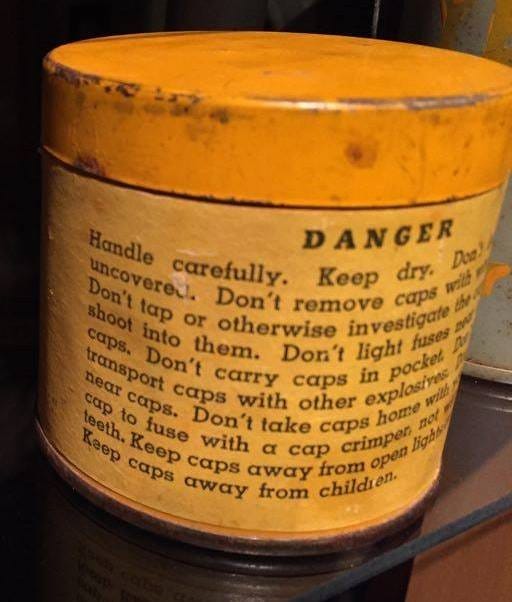
Don’t carry caps in pocket.
Image: US Demolition Equipment, Google Images
What was the source of this apocryphal tale? The first published story connecting Cap Kidd to blasting caps did not appear until 2014, the year of UTEP’s centennial. This time of heightened interest in the university’s history brought out many tall tales. Claudia Rivers, director of UTEP’s special collections, believed that the story originated with Eleanor Duke, a biology professor who first arrived on the campus of the College of Mines in 1935 as a student, and who taught at UTEP for over fifty-years (she retired in 1985). Widely regarded for her institutional memory, Duke, however, arrived well after Kidd acquired his nickname. Her oral history could not be corroborated.
The editors of the 1939 Flowsheet provide the best epilogue to this story: “Cap’s cheery personality makes him invaluable to campus life; and since he has supervised most of the blasting done on the ground, he is unluckily the target of many tall tales.”
Tall tales, indeed.
Research Notes
Newspapers
El Paso Times (newspapers.com)
El Paso Herald/El Paso Herald-Post (newspapers.com and newspaperarchive.com)
Prospector (newspaperarchive.com)
Archival Sources
Lurline Coltharp, interview by Rebecca Craver, 27 January 1984, tape 676, transcript, Institute of Oral History, UT El Paso C.L. Sonnichsen Special Collections.
James M. Day, "John William 'Cap' Kidd," Nova 25, no. 2 (Winter, 1982), 23-26.
Faculty Minutes, C. L. Sonnichsen Special Collections, UT El Paso, Tex.
Francis L. Fugate, Frontier College: Texas Western at El Paso, the First Fifty Years (El Paso: Texas Western Press, 1964).
Nancy Hamilton, UTEP: A Pictorial History of the University of Texas at El Paso, Diamond Jubilee, 1914-1989 (El Paso, Tex.: Texas Western Press, 1988).
Claudia Rivers (director, C. L. Sonnichsen Special Collections), in discussion with author, January 2018.
Jeanette Smith, "Cap Kidd's Marvelous Earthquake Machine." Nova 4, no. 2 (Winter, 1969), 12-14.
P. J. Vierra, “Individuals," Chap. 10, In The Miners History Sourcebook, Abridged, (El Paso: UT El Paso, 2022).
[1] Fugate, Frontier College, 16.
[2] UT El Paso, faculty minutes, 2 Nov. 1921. Four decades of annual salaries and itemized expenses can be found in the minutes of the board of regents and in the biennial appropriation bills passed by the state legislature.
[3] UT El Paso, faculty minutes, 12 April 1921; ibid, 2 Feb. 1927.
-The Encyclopedia of UTEP History